
Budget and Migration Update 2026
On the 12th May 2026, as part of the Federal Budget, the Government has decided on a few key migration issues, such as the Migration Program planning level, the refinement of the Points Test for the Skilled visas (subclass 189, 190 and 491), the expansion of the WHV ballot and faster occupational licencing for migrant trade workers. Here is a summary of what you should know.
Net Overseas Migration Statistics
The budget was announced at a time when Australia’s Net Overseas Migration (NOM) is forecast to reach 295,000 for the 2025–2026 financial year. While NOM has declined from 310,000 in 2024-25, it remains above the pre-pandemic average of 230,000, mostly due to lower departure rates of migrants within Australia and higher rates of New Zealanders moving to Australia.
As a result, the Government has re-oriented the allocations of the Migration Program planning level (total of 185,000 spots) to further focus on applicants already in Australia, so as to minimize the impact on the NOM.
Current Planning Level Announced
As illustrated in the chart below, over the past three years, the planning level for Regional visas have been more than halved (33,000 to 14,110) to the benefit of Employer-Sponsored visas (44,000 to 58,040) and Skilled Independent visas (16,900 to 21,090). While the planning level for Talent and Innovation visas have seen a slight decrease (5,300 to 3,500), the State/Territory Nominated visas show a slight increase (33,000 to 35,000).
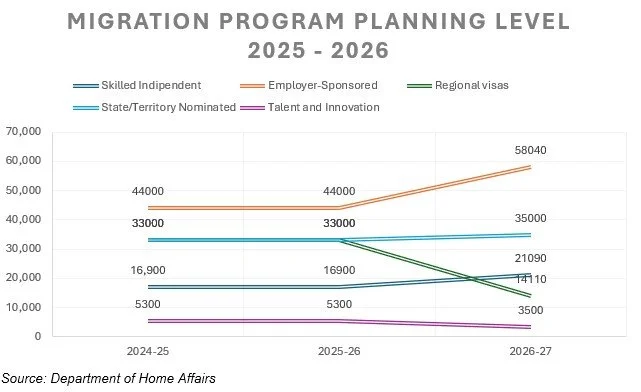
This statistics is consistent with the Government’s intention to prioritize onshore applicants which can be sponsored by their employers, State/Territory governments, or apply through the Skilled Independent pathway.
Changes to Family Visa Program and Longer Processing for Parent Visas
Significant changes can also be observed in the Family Migration Program. While the planning levels for Partner and Child visas only increased slightly, there is a notable reduction of 1,440 spots in the Parent visa category, representing an approximately 18.7% decrease from the previous year.
Currently, all Parent visas are subject to capping and queuing arrangements. As at March 2026, the DHA is assessing Contributory Parent visas (subclass 143, 173, 864, 884) queued up to November 2018 and Parent visas (subclass 103 and 804) queued up to July 2013. As a result of the current budget and reduction in allocation to this category, we are expecting further delays in the processing timeframe for Parent visas.
Changes to Points Test System
The Points Test is another key aspect that is set to undergo changes, as announced in the recent budget. The system has been a cornerstone of the eligibility criteria for the subclass 189, 190 and 491 visas since 2012.
The main driver behind the proposed change is the need to improve Australia’s stagnant productivity growth rate. To this end, the Points Test will be reformed so that it can attract higher calibre candidates, including those who are better educated, more highly‑skilled and younger. As a result, applicants with stronger English proficiency, younger age, and higher educational attainment are likely to have a competitive advantage over older, less educated, or less English-proficient candidates.
At this stage, however, it remains unclear which specific qualifications, occupations, or skill sets will be prioritised under the revised framework.
Other Changes
The Government has also announced future changes to the working holiday maker (WHM) program in order to better control application volumes. Currently, only applicants from China, India and Vietnam are required to go through a visa pre-application (ballot) process. Under the proposed reforms, the government will extend the use of ballot systems to allocate WHM spots in participating countries.
Lastly, the Government has allocated $85.2 million over four years to support faster skills assessments for migrant trades workers and to accelerate occupational licencing processes. It is anticipated that these measures could reduce the time required for migrants to enter the workforce by up to 6 months and facilitate the addition of up to 4,000 skilled trade workers per year.
We hope the above information is helpful. Should you require any further information on Australian migration, or wish to better understand how these changes may impact your business and your employees’ work rights, please do not hesitate to contact us at any time.